
Paul's Discipleship Method
And How Sympathy and Affirmation Fit in the Equation


The Bible has a full reservoir of texts that encourage us to disciple one another. . .
“encourage one another, and stir each other up” (1 Thess 5:11),
“let us consider how to stir up one another to love and good works” (Heb 10:24-25),
“make disciples of all nations” (Matt 28:19-20),
“what you have heard from me. . . commit to faithful men who will be able to teach others also” (2 Tim 2:2), and many more.
But how do you disciple someone? Does it have to be formal? What process should you follow? In this article, I simply want to follow Paul’s lead in how he disciples Timothy in 2 Timothy 1:3-7. Paul doesn’t announce he is discipling Timothy or that he intends to give us a discipleship method. Regardless, I think Paul lays out a great 5-step discipleship method—a process any Christian can follow.
Timothy’s Struggle
Paul wrote 2 Timothy to exhort a struggling Timothy. In verse 4, Paul recalls a time he had seen Timothy struggle to the point of tears. Why was he crying? Verse 7 hints that Timothy was fearful, and in verses 8-18 we learn the fear stemmed from suffering for the sake of Christ. In short, Timothy was scared to the point of tears because he witnessed the saints being persecuted. As Paul remembers the tears (notice the 4 uses of “remember/remind” in these verses), he writes a letter speaking into this struggle, to disciple Timothy. Discipleship offers this benefit of having someone outside of us help us navigate our fears, insecurities, blind spots, and struggles.
5 Ways Paul Approaches Timothy
1. Paul Prays for Timothy
“I remember you constantly in my prayers night and day” (1:3b)
Paul’s life had a regular rhythm of prayer thumping throughout. As he prayed, his ministry partner, Timothy, constantly came to mind. Before Paul writes Timothy a letter, before they sit down for a discipleship session, before he makes a phone call, Paul spent regular time praying for Timothy. Paul’s rhythm with God in prayer spills out in a rhythm of discipleship. This suggests that we might be more inclined to disciple others in a healthy way if we had a rhythm of prayer first.
I also suggest that this demonstrates Paul’s self-control and God-oriented view of discipleship. Often, the needs of others demand our immediate intervention, whether from our point of view or the person in need. We might put the pressure on ourselves—thinking that unless we intervene and address the issue immediately, all will be lost. Others might put the pressure on you, letting you know that unless you help them, they are ruined. This is rarely the case. Issues don’t arise in an afternoon, and they don’t resolve in an evening. But God can resolve them, and he might even equip his people to solve the problem through discipleship. But the process begins in prayer. When we orient rightly to God, he will equip us to serve others.
2. Paul Is Thankful for Timothy
“I thank God. . .as I remember you constantly in my prayers night and day” (1:3)
As Paul prayerfully remembers Timothy, his fear, and his tears, he surprisingly thanks God. His disposition towards Timothy is “thank you, God, for Timothy.” He doesn’t call Timothy a wuss. He doesn’t launch into exhortation. He doesn’t mull over his immaturity and fear. He thanks God for Timothy. Paul was thankful for his brother who struggled in his walk with God. Paul was the type of person who could notice someone struggling and speak into it without writing that person off. Paul noticed both Timothy’s struggle, and things about him to thank God for. This disposition naturally stirs up the person you disciple because the process is enforced with hope.
3. Paul Sympathizes With Timothy
“As I remember your tears, I long to see you, that I may be filled with joy” (1:4)
Paul then sympathizes with Timothy. In other words, he says, “I know you're struggling, and I wish I was there with you so that I could see you in person and restore joy to you and consequently to me.” You can’t skip sympathy. When you know someone’s struggling, you should strive to sympathize with them. We all relate to the need for a friend who sympathizes. As relational beings, we regularly wish—“I wish someone knew how I felt so that I wasn’t alone.” “No one knows what I’m going through.” Paul, as a friend, expresses—“I remember, I saw, I know, and I wish I was with you.”
Some people naturally sympathize, while others do not. I think we can all agree that it’s easier to spot someone's weaknesses and want to give them our list of solutions rather than taking the necessary time to be present with them and let them express the emotions they wrestle with. I personally am far too quick to interrupt someone too early during the sympathy stage. Sometimes you need to interrupt, or the person will spiral all day—but not too early. Discerning the timing takes patience, maturity, and wisdom, but you can’t skip it. It’s encouraging to watch Paul, the theologian, express warm friendship to Timothy, and it’s also an encouragement for us to sympathize with others.
4. Paul Affirms Timothy
I am reminded of your sincere faith, a faith that dwelt first in your grandmother Lois and your mother Eunice and now, I am sure, dwells in you as well” (1:5)
In verse 5, Paul affirms Timothy’s faith. He does this by affirming the faith of Timothy’s lineage and connecting it to Timothy’s faith. Paul doesn’t only remember Timothy’s tears. He also remembers his sincere faith. He encourages Timothy that he’s seen more than just his tears, he’s also seen him demonstrate sincere faith—the same faith his mom and grandma demonstrated.
As stated before it’s easy to spot peoples weaknesses. If you only have a mind that spots weaknesses, you will only tear people down. But if you have a mind that can spot grace in people’s lives, you will find traction to build people up. You will see them with gospel potential–you will see what God can do in them. When you can see that, when you find the traction of spotting grace in people, you will build them up.
Biblical Sympathy and Affirmation
At this point I want to ask: How do we implement the sympathy and affirmation steps of discipleship if the other person isn’t thinking or feeling biblically?
I suggest that Paul does not affirm Timothy’s feelings as he sympathizes and affirms. Often when we see someone in tears, we want to help them, to comfort them, to wipe away the tears with our presence and words. However, this often takes the form of affirming their feelings, feelings that aren’t always in line with the Bible.
Similarly, when you struggle and have tears, the impulse is to want someone to come alongside you to affirm and comfort you and say, among other things, “you have every right to the feel the way you feel,” “you didn’t do anything wrong,” and so on.
Our feelings can often be in the driver seat of our lives and we can use them to manipulate others. Delilah came to Samson in tears to get him to tell her his secret (Judges 16). Ahab was vexed and sullen when he didn’t get the vineyard he wanted. He sulked and faced the wall until his wife took action (1 Kings 21). Neither Delilah or Ahab had anything virtuous in their tears—but they both got what they wanted. I imagine we have all similarly hoped that the look on our face, the amount of tears we cry, or the level of anger we express could get us what we want.
I’m not suggesting that Timothy’s manipulating Paul. Rather, I suggest that you can sympathize and affirm someone without sympathizing and affirming unbiblical thoughts and feelings. Paul models this in 2 Tim 1:3-7. He shows us how to love someone who is struggling without encouraging them where their feelings don’t line up with the Bible or what God says.
5. Paul Exhorts Timothy
For this reason I remind you to fan into flame the gift of God, which is in you through the laying on of my hands, 7 for God gave us a spirit not of fear but of power and love and self-control.
After prayer, thankfulness, sympathy, and affirmation, Paul exhorts Timothy. Paul aimed the exhortation specifically at Timothy’s fear which threatened the flame of Timothy’s ministry. Timothy is exhorted by Paul to recall both the gift of ministry and the power, love, and self-control that comes from God. Suffering and persecution can be endured with those fruits of the Spirit that come from God. . .
The power gives strength to endure.
The love gives motivation to endure.
The self-control gives the stability to endure.
The rest of the book continues the exhortation. Paul recalls the gospel throughout and calls Timothy to endurance, preaching, and discipleship. Exhortation as Paul models, probes someone to think, feel, and act according to reality—the truth of God and his Word.
Conclusion
Paul displays 5 ways to approach a brother or sister who is suffering:
Pray for them.
Thank God for them.
Sympathize with them.
Affirm them.
Exhort them.
A discipleship process such as this requires a certain lifestyle. A lifestyle of prayer, patience, grace, wisdom, and courage. It’s worth striving after because it’s the way God has ordained to keep us faithful. We need the church to stir each other up to love, good works, and endurance in suffering.
Textual Phrase Diagram1
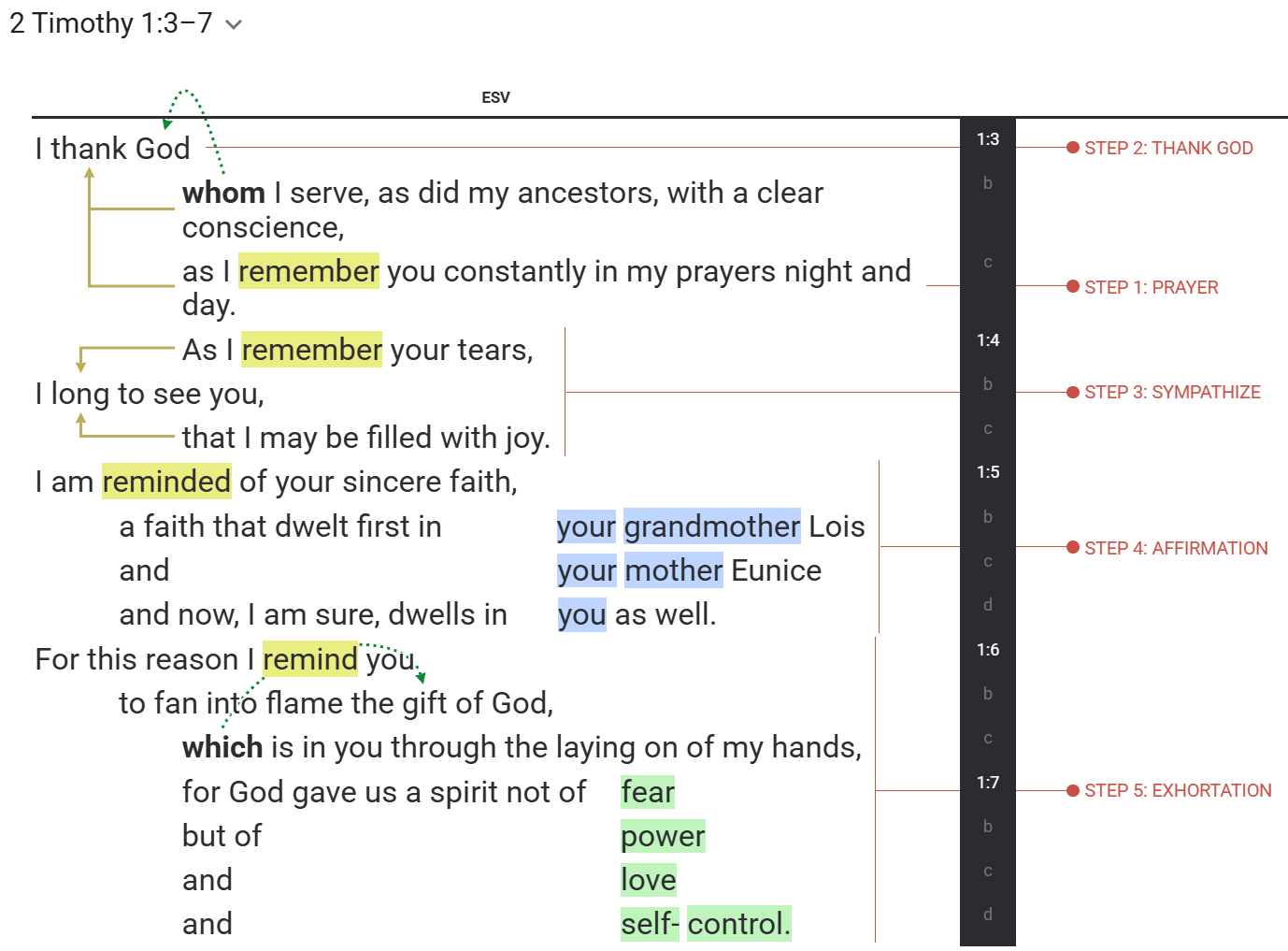
I use Biblearc.com to diagram the text. I fully recommend.
Great post, Daniel. Helpful. Somewhere along my life path, someone told me we should have/be a Paul, a Barnabas, and a Timothy.