
I Read War and Peace
Was it worth it though....

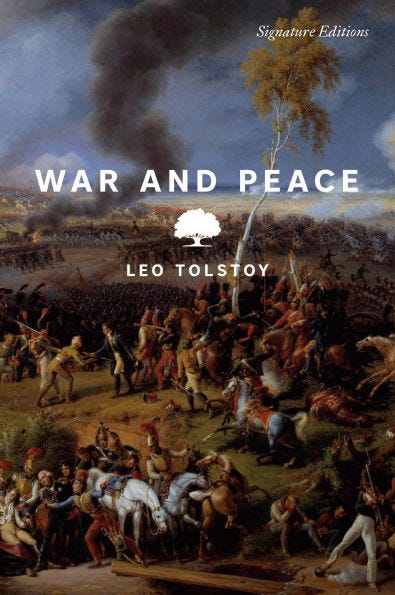
I finished War and Peace this week. I basically cut out all other intake of information for 4 months and plowed through it. Overall, given its popularity, my expectations were too high. But here’s what stood out.
Historically
As someone who doesn’t know much history, I learned a lot about the Napoleonic Wars. Tolstoy had an obvious bias on the historical elements that were hard to sort through since it wasn’t technically a historical textbook. It felt more like random opinions.
Philosophy
I didn’t find the philosophical musings convincing by the way he argued. Tolstoy mainly seemed to critique the idea that we can’t attribute all things that happened to a single, individual—particularly Napoleon. He believes in ultimate providence, but that we can’t completely know why things happen in the mundane because of so many things that contribute to why things happen the way they do. He thinks that the desire to attribute all things to Napoleon is a grasp at control that we don’t have. Yet, he seemed to soften his view when he talked about Kutuzov. It all seemed repetitive and didn’t really develop until the final epilogue. I agree overall, but don’t share the pessimistic view of leadership. Leaders are fundamentally influential people.
Character Development
The book had a ton of characters. Development seemed weak given the enormity of the book, except for Pierre and Natasha. My favorite characters from the beginning were Pierre and Natasha and I had no clue they would end up together which was fun.
General Story
More than anything, it was a joy to spend so much time with the same characters and in the same story. It was generally enjoyable to “escape” this world and enter into the world of War and Peace everyday. I regularly wondered how different aspects of the story contributed to the overall story. For example, I still don’t quite understand the hunting chapters, but it was fun--maybe that’s the point?
I read one author say to not include anything in the story that does not come up again later or have some deeper significance. But that would make a very formulaic and linear story. The wide-ranging and somewhat mundane details Tolstoy includes serve to widen the world and flesh out the characters. In the hunting, for example, you see Natasha's innocence and somewhat wild nature as well as Nikolay's mostly good-natured brashness. So the world feels more real, and it's just fun, like you said.
I agree with you that leaders are influential and necessary. But it doesn't seem out of bounds to say God uses leaders to accomplish his will, so God can be sovereign while leaders are necessary and effective at the same time. Maybe acknowledging that we are instruments in God's hand turns our efforts from fighting against "fate" to going with the flow of God's leadership and guiding. So instead of God's sovereignty being a cause for inaction in the mundane it could be instead a call to even greater action that is submissive to God's will. Kutuzov seems to accept his role as leader of the army while submitting entirely to God's guidance and will (according to Tolstoy, I don't know the real history either).
Hope this made sense, I enjoyed reading your notes.